
[ez-toc]
As security companies grow, accountability becomes increasingly difficult to maintain.
Managing guards at one or two locations is relatively straightforward. Supervisors can visit sites regularly, communicate directly with officers, and quickly identify operational issues. But when a company expands to five, ten, or even fifty sites, maintaining the same level of oversight becomes significantly more challenging.
Without the right systems in place, managers lose visibility into daily operations, communication gaps begin to appear, and clients start questioning whether services are being delivered as promised.
This is why security guard accountability has become one of the most important priorities for modern security companies.
In this article, we’ll explore why accountability often declines as operations scale and how technology can help security teams maintain visibility, consistency, and control across every site.
Why Accountability Declines as Security Companies Grow
Growth is a positive sign for any security company, but it also introduces new operational challenges.
As more sites are added, supervisors can no longer rely on physical presence to monitor guard activity. Instead, they must manage larger teams across multiple locations, often with limited visibility into what’s happening in the field.
Several common problems begin to emerge:
- Guards working independently with minimal supervision
- Delayed or incomplete incident reporting
- Missed patrols or assigned tasks
- Inaccurate timekeeping records
- Poor communication between shifts
- Limited insight into site performance
- Difficulty proving service delivery to clients
The larger the operation becomes, the harder it is to identify these issues before they affect client satisfaction.
Accountability doesn’t disappear because guards stop doing their jobs. It declines because managers lose visibility into daily activities.
The solution is not more paperwork or more phone calls.
The solution is better operational visibility.
Accountability Starts with Visibility
You can’t manage what you can’t see.
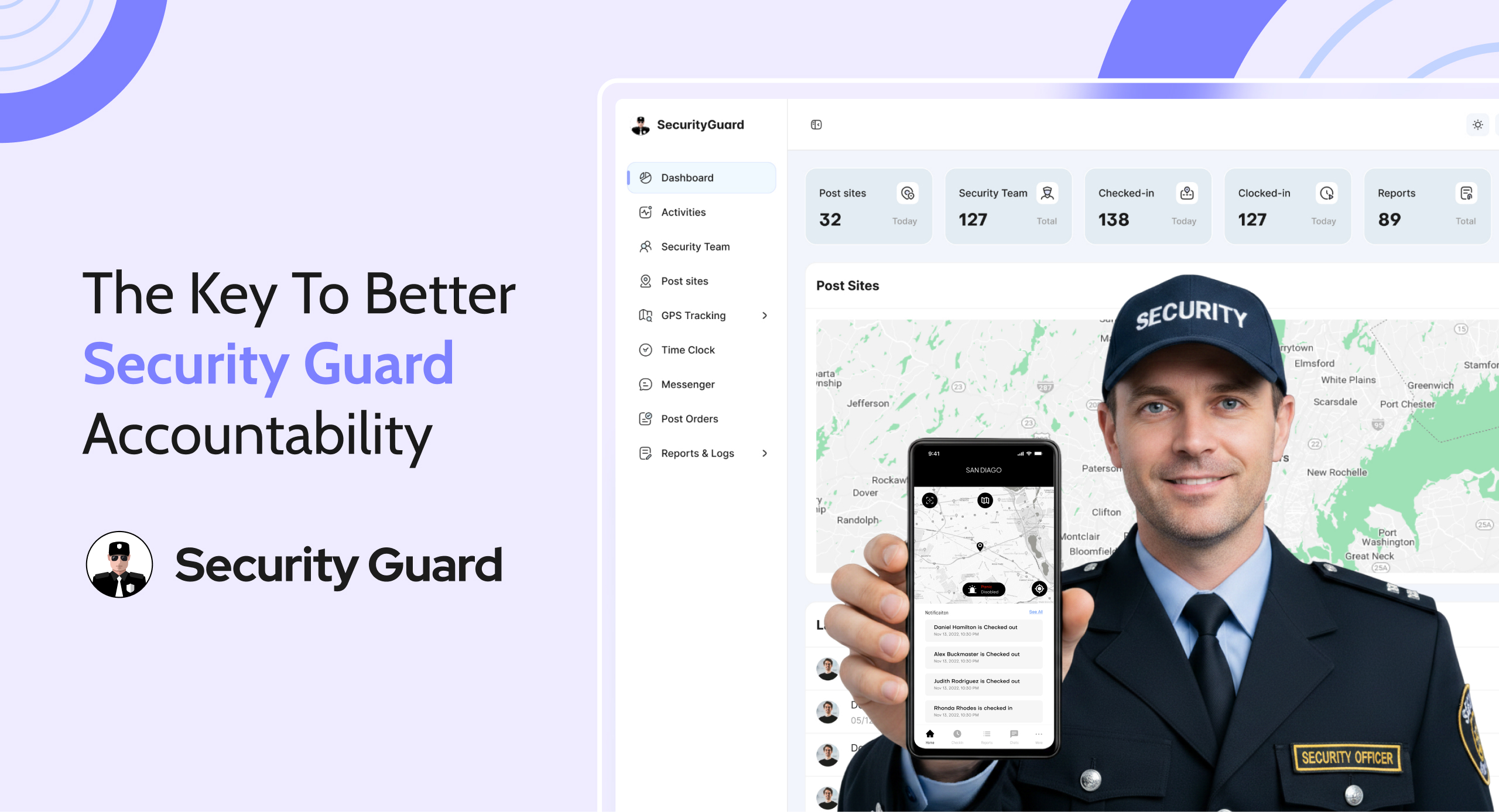
The most successful security companies create accountability by giving supervisors real-time visibility into guard activity, site conditions, and operational performance.
Instead of waiting for end-of-shift reports or client complaints, managers can identify issues as they happen and take corrective action immediately.
Modern security technology provides the tools needed to create this visibility at scale.
Use GPS Tracking to Verify Guard Activity
One of the most effective ways to improve security guard accountability is through GPS tracking.
Without location verification, supervisors often have no reliable way to confirm whether guards are actively covering assigned locations.
GPS tracking provides real-time visibility into guard movements and site presence.
Managers can quickly verify:
- Whether guards are on-site
- Arrival and departure times
- Patrol completion
- Coverage of assigned locations
- Activity during shifts
This level of transparency benefits both security companies and their clients.
For managers, it creates confidence that operations are running as expected.
For clients, it provides documented proof that contracted services are being delivered.
Most importantly, GPS tracking encourages accountability because officers know their activity is being verified.
Improve Timekeeping with Digital Time Clocks
Payroll disputes and attendance issues are common challenges in the security industry.
Traditional timekeeping methods often rely on paper records, manual entry, or supervisor approval, creating opportunities for errors and inconsistencies.
Digital time clocks help eliminate these problems by providing accurate, verifiable attendance records.
When guards clock in and out using a mobile app, supervisors gain immediate visibility into:
- Shift attendance
- Late arrivals
- Missed shifts
- Overtime activity
- Labor utilization
Accurate timekeeping improves accountability because expectations become clear and measurable.
It also reduces administrative work while improving payroll accuracy.
Standardize Reporting Across Every Site
Reporting is one of the clearest indicators of guard performance.
Unfortunately, many security companies still struggle with inconsistent reporting standards.
Some officers submit detailed reports.
Others provide minimal information.
Some reports arrive immediately.
Others arrive hours or days later.
These inconsistencies create blind spots for supervisors and make it difficult to evaluate performance objectively.
Digital reporting systems solve this problem by standardizing how information is collected and submitted.
When guards complete reports through a centralized platform, organizations benefit from:
- Consistent report quality
- Faster report submission
- Improved incident documentation
- Better record retention
- Easier performance monitoring
Supervisors can quickly identify reporting trends and address issues before they become larger operational problems.
Give Supervisors Real-Time Operational Visibility
Accountability is strongest when supervisors have immediate access to operational information.
Traditional management methods often rely on:
- Phone calls
- Text messages
- Paper reports
- Site visits
While these methods still have value, they don’t provide the real-time visibility required to manage multiple locations effectively.
Modern security operations require a centralized view of field activity.
When supervisors can access information from every site in one place, they can:
- Monitor guard performance
- Review reports instantly
- Track attendance
- Verify site coverage
- Respond to incidents faster
- Identify operational risks
This visibility allows managers to spend less time gathering information and more time improving performance.
Create a Culture of Accountability
Technology alone does not create accountability.
It supports accountability.
The most effective security organizations combine technology with clear expectations and consistent management practices.
To strengthen accountability across multiple sites:
Establish Clear Performance Standards
Guards should understand exactly what is expected during every shift.
This includes reporting requirements, patrol responsibilities, attendance expectations, and communication procedures.
Measure Performance Consistently
Accountability requires objective data.
Using GPS tracking, time clocks, and reporting metrics helps managers evaluate performance fairly and consistently.
Address Issues Quickly
Small problems become larger problems when ignored.
Real-time visibility allows supervisors to intervene before operational issues affect clients.
Recognize Strong Performance
Accountability is not only about identifying mistakes.
Recognizing officers who consistently perform well helps reinforce positive behaviors throughout the organization.
How Modern Security Technology Supports Accountability
Today’s security companies need more than basic scheduling and communication tools.
They need operational visibility.
A modern security platform helps organizations improve accountability through:
- GPS tracking
- Digital time clocks
- Real-time reporting
- Team communication
- Passdown logs
- Supervisor dashboards
- Incident documentation
Together, these tools create a connected operation where managers always know what’s happening across their sites.
Instead of relying on assumptions, they can make decisions based on real-time information.
Final Thoughts
As security companies expand, accountability becomes increasingly difficult to maintain.
The challenge isn’t a lack of effort from guards or supervisors.
The challenge is visibility.
Without accurate information, managers cannot effectively monitor performance, verify service delivery, or identify operational issues before they impact clients.
By implementing tools such as GPS tracking, digital time clocks, standardized reporting, and real-time operational dashboards, security companies can create a culture of accountability across every site they manage.
The organizations that succeed in the future won’t necessarily be the ones with the largest teams.
They’ll be the ones with the clearest visibility into their operations and the strongest systems for maintaining accountability at scale.
Leave A Comment