
Managing guard attendance sounds simple until your security company has officers working different hours across multiple client sites.
One guard forgets to clock in. Another records the wrong time. A supervisor has to call three sites to confirm who is actually working. At the end of the week, someone still has to review timesheets before those hours can be used for payroll.
These small tasks quickly become a significant administrative burden as a security company grows.
Security guard time tracking gives companies a better way to record when guards start and finish work, monitor attendance, manage breaks, and maintain accurate time records without relying entirely on paper timesheets or spreadsheets.
But modern time tracking should do more than simply record hours.
When connected with GPS tracking, reporting, communication, post orders, and other guard-management tools, it can give supervisors a much clearer picture of what is happening across their security operation.
Here are eight ways digital time tracking can improve security team efficiency.
What Is Security Guard Time Tracking?
Security guard time tracking is the process of digitally recording when a guard begins and ends a shift and how much time they spend working.
Instead of writing arrival and departure times on paper, guards can use a mobile or web application to clock in and out.
The system creates an electronic record of their working time that supervisors can review later.
A modern security guard attendance system may help managers monitor:
- Clock-in times
- Clock-out times
- Total hours worked
- Break duration
- Active guards
- Attendance history
- Time-log corrections
- Site activity
For security companies managing guards across multiple locations, having this information in one system can significantly reduce the amount of manual attendance administration.
Security managers who want to understand the underlying process can also read our guide to how a digital time clock for security guards works.
Why Traditional Guard Timekeeping Creates Problems
Paper timesheets and spreadsheets can work when a security company has only a few employees.
The problems become more noticeable as the operation expands.
Imagine managing 30 guards across eight client sites.
At the end of the week, supervisors may need to determine:
- Who arrived on time?
- Who forgot to clock out?
- Which hours belong to which guard?
- How long were breaks?
- Was an incorrect entry made?
- Which attendance records need correction?
- Which guards were actually working during a specific period?
When these answers are spread across paper sheets, text messages, phone calls, and spreadsheets, administrative work increases.
Human Error
Guards or supervisors may accidentally enter the wrong time.
Even a small mistake can affect the final number of hours recorded.
Missing Information
Paper records can be incomplete, misplaced, damaged, or submitted late.
A missing clock-out can require supervisors to contact the employee and manually reconstruct the shift.
Limited Real-Time Visibility
A paper timesheet tells you what happened after someone writes it down.
It does not necessarily give a manager immediate visibility into current attendance across multiple security sites.
Digital security guard time tracking helps bring those records into a central system.
1. Make Clocking In and Out Easier for Guards
Time tracking should not create another complicated task for guards.
The easier it is to record attendance correctly, the more likely the company is to maintain consistent records.
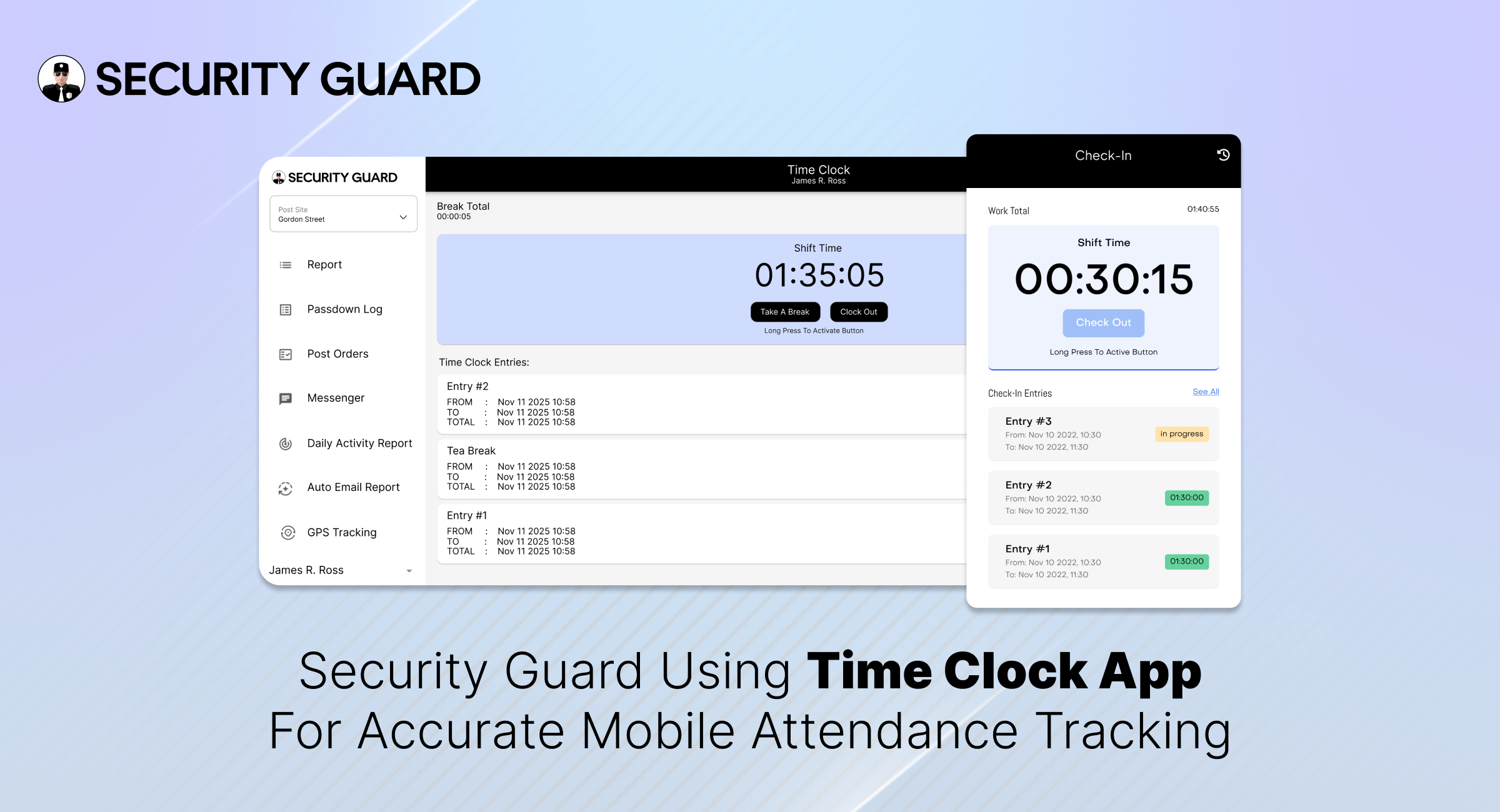
With the SecurityGuard.app Time Clock, guards can clock in and out using a mobile device or computer. The platform automatically captures the time spent after the guard clocks in.
That removes the need to:
- Fill out paper timesheets
- Return attendance sheets to an office
- Maintain separate spreadsheet entries
- Rely entirely on supervisors to record hours manually
Consider two workflows.
Manual process:
Guard arrives → writes time on paper → supervisor collects sheet → admin enters hours → discrepancy is discovered → supervisor contacts guard.
Digital process:
Guard arrives → clocks in → time is recorded → supervisor can review the log.
Removing unnecessary steps reduces administrative work for both guards and managers.
2. Give Supervisors Better Attendance Visibility
One of the biggest challenges for security companies is that their workforce rarely operates from one location.
Guards may be stationed at apartment communities, corporate offices, hospitals, hotels, construction sites, campuses, retail properties, events, and warehouses.
A supervisor cannot physically visit every location just to confirm attendance.
A digital time clock for security guards gives managers a centralized view of guard time records.
SecurityGuard.app also provides live notifications when guards clock in or out, helping supervisors stay aware of attendance activity without continuously checking paper records.
This can help supervisors identify situations that may require attention earlier.
For example:
Expected shift: 8:00 PM
No normal attendance activity appears: supervisor investigates
Coverage issue confirmed: supervisor can begin resolving it
The goal is not simply to collect data.
The goal is to make attendance information useful while there is still time to act.
3. Reduce Timekeeping Errors Before They Become Bigger Problems
Mistakes happen.
A guard may forget to clock out. A supervisor may discover an incorrect entry. A legitimate attendance record may need to be corrected.
SecurityGuard.app allows authorized admins, managers, and supervisors to edit time logs and modify clock-in or clock-out records.
Accurate records matter because timekeeping information may eventually influence payroll preparation, labor-cost reviews, client billing verification, employee attendance discussions, site-performance reviews, and internal audits.
Correcting a timekeeping problem when it is discovered is much easier than trying to reconstruct what happened weeks later.
4. Track Guard Breaks More Consistently
Working hours are only one part of attendance management.
Security companies also need visibility into break time.
SecurityGuard.app allows companies to create custom breaks, define their duration, and monitor time spent on those breaks through its security guard time clock.
This creates a clearer digital record instead of relying on informal notes or memory.
Companies should configure break policies in accordance with applicable labor requirements, employee agreements, and company policies.
Digital tracking provides the record; the organization remains responsible for establishing the correct break rules.
5. Make Payroll Preparation Easier
Time tracking and payroll are closely connected, but they are not the same thing.
A time-clock system records the hours. A payroll system uses approved information to calculate compensation.
Accurate digital attendance records can make the first part of that process easier.
Instead of collecting handwritten records from every site, managers can review guard time logs from a central platform.
Without digital tracking:
Paper logs → spreadsheet entry → manual calculations → corrections → payroll review
With digital time records:
Clock-in/out data → review exceptions → confirm hours → use approved attendance records for payroll preparation
This can reduce the amount of manual data reconstruction required before payroll.
Security companies can also combine attendance information with security guard reporting to maintain more complete operational records.
6. Combine Time Tracking With GPS Visibility
Knowing when someone clocks in answers one question:
When did the guard start working?
Security managers often have another:
What is happening with the team in the field?
This is where time tracking and real-time GPS tracking for security guards can complement each other.
SecurityGuard.app’s GPS tracking provides authorized users with greater visibility into guard locations and field activity.
Instead of treating timekeeping and field management as completely separate workflows, a security company can use different parts of the platform to understand both attendance and field activity.
Clock-in data: tells the supervisor when the guard started.
GPS information: provides additional visibility into field location.
Reports: document what happened during the shift.
Together, these records provide more useful operational context than a handwritten timesheet alone.
7. Improve Accountability Across Multiple Client Sites
Managing attendance becomes increasingly complicated as a security company wins more clients.
Suppose your company operates:
- 5 guards at Site A
- 8 guards at Site B
- 3 guards at Site C
- 12 guards distributed across several smaller properties
Checking every officer manually becomes inefficient.
A centralized security guard management platform can make it easier to maintain visibility across dispersed teams.
SecurityGuard.app brings time tracking together with GPS information, security reporting, site management, and other operational tools.
This matters for growing security businesses because administrative processes need to scale alongside headcount.
A system that works for five guards may become difficult to manage when the company reaches 50 or 100.
8. Connect Attendance With the Rest of Guard Operations
The greatest limitation of a standalone time clock is that it tells you only one thing:
How long someone worked.
Security operations involve much more.
During the same shift, a guard may need to follow post orders, patrol the assigned property, report an incident, communicate with a supervisor, document daily activity, or request assistance.
This is why time tracking becomes more valuable when it exists inside broader security guard management software.
SecurityGuard.app combines tools for time tracking, GPS tracking, security reporting, communication, post orders, passdown logs, panic alerts, and other guard-management activities.
A connected shift can look like this:
Guard clocks in
↓
Supervisor gains attendance visibility
↓
Guard accesses site instructions
↓
Field activity can be monitored
↓
Guard submits reports during the shift
↓
Important information is communicated
↓
Guard clocks out
Now the time record is part of a wider operational history rather than an isolated attendance entry.
What Should Security Companies Look for in Guard Time Tracking Software?
Not every time-clock system is designed for security operations.
When evaluating software, focus on how well it fits the realities of managing guards across multiple client locations.
Look for:
- Easy mobile clock-in and clock-out
- Centralized time logs
- Editable records with appropriate permissions
- Break tracking
- Real-time attendance information
- Multi-site support
- Reporting
- Field-operations features
For many security companies, integrated security guard management software will be more practical than maintaining separate applications for attendance, reporting, field visibility, and communication.
Time Clock vs. GPS Tracking vs. Guard Reporting: What’s the Difference?
These tools are related, but they answer different questions.
| Tool | Main Question It Answers |
|---|---|
| Time Clock | When did the guard work? |
| GPS Tracking | Where is the guard? |
| Security Reporting | What happened during the shift? |
| Passdown logs | What does the next guard need to know? |
| Post orders | What is the guard expected to do? |
A security company may need several of these tools working together.
A time clock alone cannot tell managers everything that happened on a site. Likewise, GPS data alone does not replace attendance records, incident reports, or site instructions.
The objective is to create a connected operational record.
How SecurityGuard.app Supports Security Guard Time Tracking
SecurityGuard.app is designed specifically around security team operations rather than generic employee attendance.
Its Time Clock allows guards to clock in and out digitally while helping managers maintain clearer attendance records, track working hours, manage breaks, and monitor clock-in/out activity.
Time tracking can then work alongside GPS tracking to provide greater visibility into field operations.
Managers can also use security guard reporting software to maintain records of what happens during shifts.
Instead of treating attendance, location visibility, communication, and reporting as disconnected processes, security companies can manage more of their guard operations through one platform.
Frequently Asked Questions
What is security guard time tracking?
Security guard time tracking is a digital method of recording when guards start and finish work and how many hours they work. Mobile and web-based systems can replace paper attendance records and make time information easier for supervisors to review.
What is a security guard time clock app?
A security guard time clock app allows guards to clock in and out digitally. The system records their attendance so supervisors can review work-hour information.
How does time tracking improve guard accountability?
Time tracking creates a consistent digital record of when guards begin and end work. Supervisors can use that information alongside reporting and field information to identify attendance problems and maintain clearer records.
Can guard time tracking help with payroll?
Accurate clock-in, clock-out, work-hour, and break records can make payroll preparation easier by reducing dependence on handwritten timesheets and manual reconstruction of employee hours.
Is time tracking the same as GPS tracking?
No. Time tracking primarily records working hours and attendance, while GPS tracking for security guards provides field-location information. Using both can give managers a clearer picture of security operations.
Make Guard Time Tracking Part of a Better Security Operation
Accurate attendance is important, but recording hours should not consume hours of administrative time.
A digital security guard time tracking system can help companies replace paper timesheets, maintain cleaner attendance records, monitor guard hours, manage breaks, reduce manual work, and give supervisors better visibility into distributed teams.
More importantly, time tracking becomes much more useful when it connects with the rest of your security workflow.
SecurityGuard.app brings time tracking together with GPS visibility, reporting, communication, and other tools designed for managing security teams.
Instead of asking:
“Did the guard write down their hours?”
Your team can work toward a clearer picture:
Who was working, when were they working, and what was happening across the site during that shift?
That is where digital time tracking becomes more than a replacement for paper.
It becomes part of a more organized and accountable security operation.
Ready to move beyond paper timesheets? Explore SecurityGuard.app’s Time Clock and see how digital time tracking can simplify attendance management for your security team.
what is the cost
Security Guard App offers one of the most affordable and scalable solutions in the market.
👉 Explore pricing: