
[ez-toc]
Managing security guards across multiple locations is difficult when supervisors cannot see what is happening in the field.
A guard may be assigned to a property, but is the guard actually there? Has the required patrol been completed? Did the guard visit every checkpoint? What happened during the shift? And if an emergency occurs, how quickly can a supervisor identify the guard’s location and coordinate a response?
Traditional methods such as paper patrol logs, radio calls, spreadsheets, and end-of-shift reports make these questions difficult to answer in real time.
A real-time security guard tracking system changes that by connecting guard location, patrol activity, checkpoint verification, incident reporting, attendance, communication, and emergency response through digital technology.
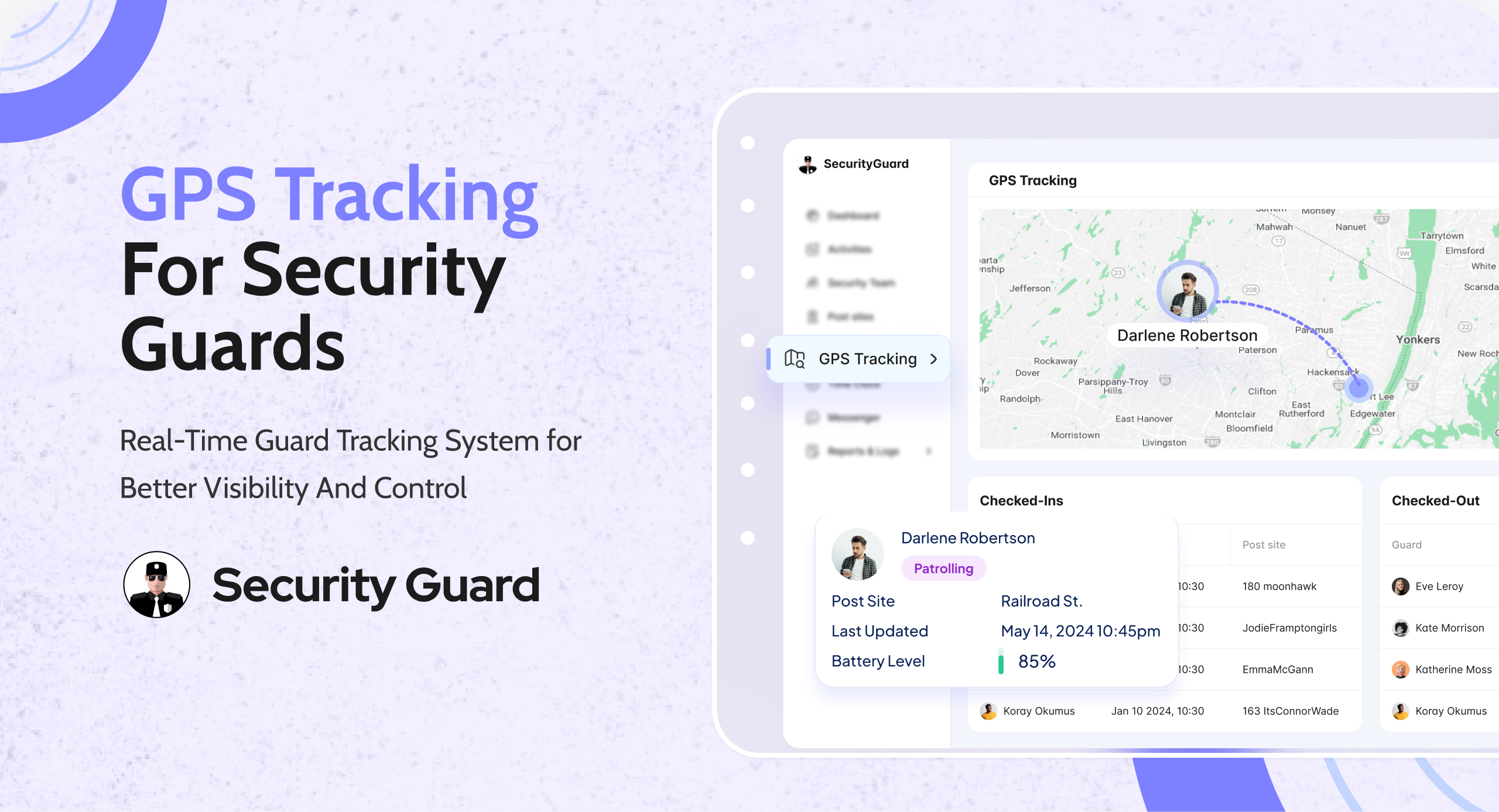
Modern security guard tracking software can provide supervisors with a live operational view while creating a digital record that can be reviewed after a shift.
For security companies, property managers, and organizations managing security teams, the goal isn’t simply to track a guard’s location.
It’s to create better visibility, accountability, and coordination across the entire security operation.
What Is a Security Guard Tracking System?
A security guard tracking system is software that uses technologies such as GPS, geofencing, mobile devices, and digital checkpoints to monitor guard activity during a shift.
Depending on the platform, a security guard tracking system can help supervisors:
- See active guards on a map
- Verify guard presence at assigned locations
- Monitor patrol routes
- Verify checkpoints
- Review historical movement
- Identify missed patrols
- Receive operational alerts
- Respond to emergencies
- Review incident activity
- Maintain digital patrol records
- Provide clients with proof of service
The most effective systems don’t treat GPS as an isolated feature.
They connect location data with other security workflows such as time tracking, patrol management, incident reporting, post orders, communication, and client reporting.
This distinction is important.
A simple GPS tracker tells you where someone is.
A security guard tracking system should help you understand what the guard is doing, where they are expected to be, whether required activities have been completed, and what action is needed when something goes wrong.
Why Traditional Guard Tracking Methods Fall Short
Many security operations still depend on manual processes.
A supervisor may call a guard to confirm their location. A guard may write patrol activity in a paper log. A client may receive a report hours after the shift ends.
These processes create several problems.
Limited real-time visibility
Supervisors cannot continuously depend on verbal updates to understand what is happening across multiple sites.
Difficult patrol verification
A completed paper patrol log doesn’t provide the same level of location-based evidence as digital checkpoint verification.
Delayed incident information
An incident documented at the end of a shift may reach management long after it occurred.
Manual recordkeeping
Paper logs and spreadsheets require additional administrative work and create opportunities for incomplete or inconsistent records.
Difficult multi-site management
The challenge becomes greater when one supervisor is responsible for guards working across multiple properties.
Limited historical information
If a client questions whether a patrol occurred, management may have little more than a handwritten record to review.
A digital tracking system addresses these challenges by turning field activity into structured operational data.
How Real-Time Security Guard Tracking Works
Although the exact workflow varies by platform, a typical system works through several connected steps.
Step 1: Create the site and patrol requirements
The security company establishes the property, guard assignments, patrol routes, checkpoints, and relevant instructions within the system.
For example, a commercial property may require guards to inspect:
- Main entrances
- Parking areas
- Loading docks
- Emergency exits
- Perimeter fencing
- Restricted areas
- Equipment rooms
Each location can have different requirements.
Step 2: Assign guards to the site
Supervisors assign guards to the appropriate post and shift.
This creates a connection between:
Guard + Shift + Site + Patrol Requirements
Step 3: Guard starts the shift
The guard checks in using the mobile application.
Depending on the platform, location information can help verify that the guard is reporting to the expected location.
Step 4: GPS tracking provides location visibility
As the guard moves through the site, the mobile application can provide location information to authorized supervisors.
This allows management to see field activity without repeatedly calling the guard for updates.
Step 5: Patrols and checkpoints are recorded
The guard follows the required patrol route and verifies designated checkpoints.
GPS can provide movement information, while technologies such as NFC or QR codes can provide additional checkpoint verification.
Step 6: Events and incidents are reported
If the guard discovers an issue, they can document it from the field using the mobile application.
Reports can include information such as:
- Date and time
- Location
- Description
- Photos
- Actions taken
- Other relevant evidence
Step 7: Supervisors review activity
Managers can monitor current operations and review historical information after the shift.
This creates a continuous operational record rather than relying entirely on end-of-shift paperwork.
10 Essential Features of a Modern Security Guard Tracking System
A good tracking system should provide more than a dot moving across a map.
Here are the capabilities security companies should evaluate.
1. Real-Time GPS Tracking
GPS tracking provides supervisors with visibility into guard locations while they are working.
A live map can help managers:
- Monitor active guards
- Verify deployment
- Coordinate mobile teams
- Identify potential coverage issues
- Understand field activity
- Locate personnel during an emergency
For companies operating multiple sites, this can significantly improve situational awareness.
However, GPS should be viewed as one layer of verification—not the entire patrol process.
A guard can be inside the correct geofence without completing the required patrol.
That’s why GPS works best when combined with patrol and checkpoint verification.
2. GPS History and Route Playback
Live location answers:
Where is the guard now?
Historical tracking answers:
Where has the guard been?
This distinction becomes important when reviewing previous shifts.
Historical location data can help managers investigate:
- Missed patrols
- Unexpected route changes
- Coverage questions
- Delayed site visits
- Client disputes
- Incident timelines
- Guard movement patterns
Security Guard App provides GPS tracking and historical route information that can be reviewed by authorized users.
3. Geofencing
Geofencing creates a virtual boundary around a defined location.
For security companies, this can help establish whether a guard is within an expected operational area.
Geofencing can support:
- Site attendance verification
- Location-based alerts
- Guard deployment
- Site monitoring
- Patrol management
- Coverage verification
For example, a supervisor could establish a geographic boundary around a client property.
If the guard moves outside the defined area unexpectedly, the system can flag the activity depending on the configured rules.
GPS vs. geofencing
These terms are often used interchangeably, but they aren’t the same.
GPS provides location information.
Geofencing uses location information to create rules around geographic areas.
Used together, they can provide stronger operational visibility.
4. Digital Checkpoints and Patrol Verification
A tracking system should help answer more than:
“Was the guard at the property?”
It should also help answer:
“Did the guard complete the required patrol?”
Digital checkpoints can be verified using technologies such as:
- NFC
- QR codes
- GPS
- Barcodes
- Bluetooth-based technologies
For example:
Checkpoint 1 → Main entrance
Checkpoint 2 → Parking area
Checkpoint 3 → Loading dock
Checkpoint 4 → Emergency exit
Checkpoint 5 → Perimeter
Each completed checkpoint can become part of the patrol record.
This creates a more structured way to verify that required areas were inspected.
Competitor solutions also combine geofenced checkpoints with GPS-based verification and time-stamped patrol records.
5. Automated Alerts and Notifications
Supervisors shouldn’t have to constantly watch every guard on a map.
Automated alerts can help direct attention toward exceptions.
Depending on the system, alerts can be configured around events such as:
- Missed checkpoints
- Delayed activity
- Location exceptions
- New incident reports
- Emergency alerts
- Other predefined events
This supports an exception-based management model.
Instead of manually checking every guard, supervisors can spend more time addressing situations that actually require intervention.
6. SOS and Panic Alerts
Guard tracking becomes even more valuable when it connects with emergency response.
A panic or SOS feature can give guards a quick way to alert supervisors when they encounter a dangerous situation.
Potential situations include:
- Physical confrontation
- Medical emergency
- Threatening behavior
- Unauthorized intrusion
- Fire or hazardous conditions
- Lone-worker emergencies
When an SOS alert is connected to location information, supervisors can have additional context about who needs help and where they are located.
PSIBORG’s approach similarly combines SOS alerts, GPS monitoring, and checkpoint verification as part of its real-time monitoring concept.
A panic button is only one part of emergency preparedness, however. Security companies should also define who receives the alert, escalation procedures, backup contacts, and what the guard should do next.
7. Incident Reporting With Location and Evidence
GPS data becomes significantly more useful when it is connected to incident reporting.
Instead of simply recording that an incident happened, a digital report can connect:
Guard + Site + Time + Location + Incident + Evidence + Action Taken
A guard can document an incident directly from the field and attach supporting information such as photos.
This can improve the speed and consistency of incident documentation while giving supervisors more context for follow-up.
8. Real-Time Guard Activity Monitoring
A modern tracking system can provide a broader picture of field activity than GPS alone.
Managers may want to know:
- Which guards are currently active?
- Which guards are at their assigned sites?
- Which patrols are in progress?
- Which checkpoints have been completed?
- Which incidents were reported?
- Are there any outstanding issues?
Bringing this information into one dashboard reduces the need to piece together information from multiple tools.
Security Guard App’s current platform brings GPS tracking together with features such as time tracking, reports, post sites, teams, post orders, and communication.
9. Historical Records and Audit Trails
Real-time visibility is useful, but historical data is equally important.
Security companies may need to review previous activity when:
- A client questions service delivery
- An incident requires investigation
- A supervisor reviews guard performance
- Management identifies recurring problems
- A contract is being reviewed
- A dispute arises regarding patrol completion
Digital records provide a more searchable and structured alternative to paper logs.
Historical information can also help management identify patterns over time rather than treating every shift as an isolated event.
10. Client Visibility
Clients increasingly want evidence of the services they are paying for.
Instead of simply saying:
“The patrol was completed.”
security companies can provide appropriate digital evidence of activity.
Depending on the system and permissions, client visibility can include:
- Patrol records
- Incident reports
- Guard activity
- GPS information
- Time records
- Site activity
- Other service documentation
This can reduce repetitive reporting requests while giving clients greater transparency.
GPS Tracking Alone Isn’t Enough
This is one of the most important points when evaluating security guard tracking software.
A GPS tracker can tell you that a guard was near a property.
It cannot necessarily prove that the guard:
- Inspected every required area
- Checked a particular door
- Visited an emergency exit
- Investigated a suspicious activity
- Followed the correct patrol sequence
- Completed a specific inspection
That’s why a strong security operation can combine multiple layers:
Layer 1: Time tracking
Was the guard working?
Layer 2: Geofencing
Was the guard within the expected area?
Layer 3: GPS tracking
Where did the guard move?
Layer 4: Checkpoint verification
Did the guard visit the required locations?
Layer 5: Reporting
What did the guard observe?
Layer 6: Evidence
Can the activity be supported with photos or other records?
Layer 7: Communication
Could supervisors and guards coordinate when something changed?
Together, these provide a much stronger operational picture than GPS alone.
Security Guard Tracking System vs. Basic GPS Tracker
| Capability | Basic GPS Tracker | Security Guard Tracking System |
|---|---|---|
| Live location | ✓ | ✓ |
| Location history | ✓ | ✓ |
| Geofencing | Sometimes | ✓ |
| Patrol routes | Limited | ✓ |
| Checkpoint verification | Usually no | ✓ |
| Incident reporting | No | ✓ |
| Photos/evidence | No | ✓ |
| Guard time tracking | No | ✓ |
| Post orders | No | ✓ |
| Supervisor alerts | Limited | ✓ |
| Emergency/SOS workflow | Limited | ✓ |
| Client reporting | No | ✓ |
| Operational dashboard | Limited | ✓ |
The distinction is important when comparing software.
If your only requirement is knowing where a vehicle or phone is, basic GPS tracking may be sufficient.
If you need to manage security operations, you need a system that connects location with the rest of the workflow.
Benefits of Real-Time Security Guard Tracking
Better operational visibility
Supervisors gain a clearer view of what is happening across distributed sites.
Stronger guard accountability
Digital location and patrol records make field activity easier to verify.
Faster incident coordination
Location information can help supervisors understand where personnel are during an incident.
More consistent patrols
Digital routes and checkpoints give guards clearer expectations.
Less manual reporting
Automated digital records can reduce dependence on paper patrol logs.
Better client transparency
Security companies can provide clients with more meaningful proof of service.
Easier multi-site management
One centralized dashboard can simplify oversight across multiple properties.
More useful historical data
Managers can analyze past activity instead of relying only on verbal recollection.
Use Cases for Security Guard Tracking Software
Security guard tracking is useful across many environments.
Commercial properties
Track patrols around:
- Office buildings
- Parking areas
- Entrances
- Loading zones
- Common areas
Construction sites
Monitor guards responsible for large perimeters, equipment areas, access points, and material storage zones.
Residential communities
Track patrols through:
- Gates
- Parking areas
- Amenity areas
- Building entrances
- Perimeters
Warehouses and industrial facilities
Verify inspections around:
- Loading docks
- Storage areas
- Restricted zones
- Equipment
- Perimeter access points
Retail properties
Monitor security activity around:
- Store entrances
- Parking lots
- Back-of-house areas
- Delivery zones
- Common areas
Events and campuses
Tracking can help coordinate mobile guards across larger areas where supervisors need greater visibility into field teams.
Real-Time Tracking for Multi-Site Security Operations
The value of tracking increases as the number of sites increases.
Imagine a supervisor responsible for 30 guards across 10 properties.
Without centralized tracking, the supervisor may have to rely on:
- Phone calls
- Radio updates
- Text messages
- Paper logs
- Spreadsheets
- Separate reports
A centralized security guard tracking system can provide a single operational view.
The supervisor can see:
Who is working → Where they are → What patrols are due → What has been completed → What incidents occurred → What needs attention
This changes the supervisor’s role from constantly chasing information to managing exceptions and making decisions.
How to Measure the Success of a Guard Tracking System
Buying software is not the end goal.
The goal is to improve security operations.
Track measurable KPIs before and after implementation.
Patrol completion rate
Percentage of scheduled patrols completed successfully.
Checkpoint completion rate
Percentage of required checkpoints verified.
Missed patrol rate
Number of patrols or checkpoints that were missed.
Incident reporting time
Time between an incident occurring and the report being submitted.
Check-in compliance
Percentage of shifts with accurate and timely attendance records.
Response coordination time
How quickly supervisors can identify and coordinate the appropriate guard or response team.
Supervisor administrative time
How much time supervisors spend manually collecting information and correcting records.
Client reporting turnaround
How quickly service information can be provided to clients.
These metrics give management a better way to determine whether the software is producing operational value.
How to Choose the Right Security Guard Tracking System
Not every company needs the same solution.
Before choosing software, ask the following questions.
1. Do you need GPS tracking or full patrol management?
If you only need location information, a basic GPS solution may be enough.
If you need patrol verification, reporting, attendance, communication, and client visibility, look for a broader platform.
2. How many guards and sites do you manage?
Consider both current operations and expected growth.
A solution that works for 10 guards at one site may not be ideal for 100 guards across multiple properties.
3. Does it support checkpoint verification?
If patrol accountability matters, look for support for GPS, NFC, QR codes, or another appropriate checkpoint technology.
4. Does it provide historical tracking?
Live location isn’t enough when you need to investigate past activity.
5. Does it have emergency features?
Evaluate SOS or panic alerts, escalation procedures, and how location information is handled during emergencies.
6. Can guards report incidents from their phones?
Mobile reporting should be fast enough to use in the field.
7. Can it work alongside post orders and time tracking?
The more connected the workflows are, the less information guards and supervisors have to enter multiple times.
8. Can clients access appropriate information?
If client transparency is important to your contracts, evaluate client-facing reporting and access controls.
9. Does it work across multiple sites?
Look for centralized management of guards, teams, properties, and activity.
10. How does the system handle privacy?
GPS tracking involves employee and operational data.
Before implementation, establish clear policies around:
- When tracking is active
- Who can access location data
- How long information is retained
- How historical data is used
- What guards need to know about tracking
Technology should support accountability without creating unclear or unnecessary monitoring practices.
Best Practices for Implementing Security Guard Tracking
Start with the operational problem
Don’t begin by asking:
“Which software has the most features?”
Start with:
“What problem are we trying to solve?”
For example:
- Missed patrols
- Poor visibility
- Manual reports
- Client disputes
- Multi-site coordination
- Emergency response
- Attendance verification
Then select features around those problems.
Build site-specific patrols
Not every property has the same security requirements.
Configure patrol routes and checkpoints around actual risks.
Train guards before going live
Guards should know how to:
- Start and end shifts
- Use GPS
- Complete checkpoints
- Submit reports
- Send alerts
- Access post orders
- Handle connectivity problems
Establish clear emergency procedures
Define who receives alerts, who responds, and how incidents are escalated.
Review the data regularly
Don’t collect tracking data without analyzing it.
Use historical information to identify:
- Repeated missed checkpoints
- Coverage problems
- Unusual activity
- Training needs
- High-risk locations
- Operational bottlenecks
Communicate the purpose of tracking
Guards should understand that the objective is to improve operational visibility, accountability, safety, and service delivery.
Real-Time Security Guard Tracking With Security Guard App
Security Guard App is designed to connect GPS tracking with the wider security operation.
Its GPS Tracking capabilities provide security companies with tools for monitoring guard locations, reviewing historical movement, and improving operational visibility.
But location tracking is only one part of the platform.
Security Guard App also brings together:
- GPS tracking
- Time clock
- Guard management
- Post sites
- Digital post orders
- Custom reports
- Incident reporting
- Passdown logs
- In-app messaging
- Panic alerts
- Activity notifications
- NFC checkpoint verification
- Client access
This allows companies to connect multiple workflows instead of using one application for GPS, another for reports, and another for communication.
For example:
Guard checks in → GPS confirms location → guard completes checkpoints → guard submits activity report → supervisor receives updates → client receives appropriate service information
The value is in connecting those steps.
A tracking system should not simply tell you where your guards are.
It should help you understand what is happening across your operation and give supervisors the information they need to act.
Frequently Asked Questions
What is a real-time security guard tracking system?
A real-time security guard tracking system uses technologies such as GPS, geofencing, mobile applications, and digital checkpoints to monitor guard activity and provide supervisors with greater visibility into field operations.
How does GPS tracking work for security guards?
GPS tracking uses a guard’s mobile device to provide location information while the tracking function is active. Authorized supervisors can use this information to monitor current locations and, depending on the system, review historical movement.
What is the difference between GPS tracking and guard patrol tracking?
GPS tracking primarily provides location information. Guard patrol tracking adds operational context by connecting locations with assigned routes, checkpoints, schedules, and patrol requirements.
Can a security guard tracking system verify patrols?
Yes. Many systems combine GPS with digital checkpoints using technologies such as NFC or QR codes to provide additional evidence that guards visited required locations.
Can security guard tracking software improve accountability?
Yes. Digital location, checkpoint, attendance, and reporting records can provide supervisors with more objective information for reviewing field activity.
Can security guard tracking systems help during emergencies?
They can. GPS location information combined with SOS or panic alerts can help supervisors understand where an emergency alert originated and coordinate the appropriate response.
Can clients see guard tracking information?
Some platforms allow authorized clients to access selected operational information. Access should be controlled according to the security company’s policies and the client’s requirements.
Is GPS tracking enough for a security company?
Not necessarily. GPS is useful for location visibility, but companies that need stronger patrol accountability may also require checkpoints, incident reporting, time tracking, post orders, alerts, and historical records.
What should I look for in security guard tracking software?
Look for real-time GPS, historical tracking, geofencing, patrol verification, checkpoint management, incident reporting, emergency alerts, notifications, time tracking, reporting, multi-site management, client visibility, and appropriate privacy controls.
Final Thoughts
A modern security guard tracking system should do more than put guards on a map.
The real value comes from connecting location data with the activities that define a security operation.
GPS tells you where the guard is.
Geofencing helps establish whether they are within an expected area.
Checkpoint verification helps document patrol activity.
Incident reporting explains what happened.
Time tracking establishes attendance.
SOS alerts support emergency communication.
Historical data helps managers review what happened.
And when these capabilities work together, security companies gain a much clearer picture of their field operations.
For growing security companies, the question is no longer simply whether guards should be tracked.
The better question is:
“How can we turn guard location and activity data into better visibility, accountability, response, and client service?”
That is where a connected, real-time security guard tracking system can become a core part of smarter security operations.
👉 Request a demo or explore GPS Tracking:
https://www.securityguard.app/gps-tracking
Leave A Comment