
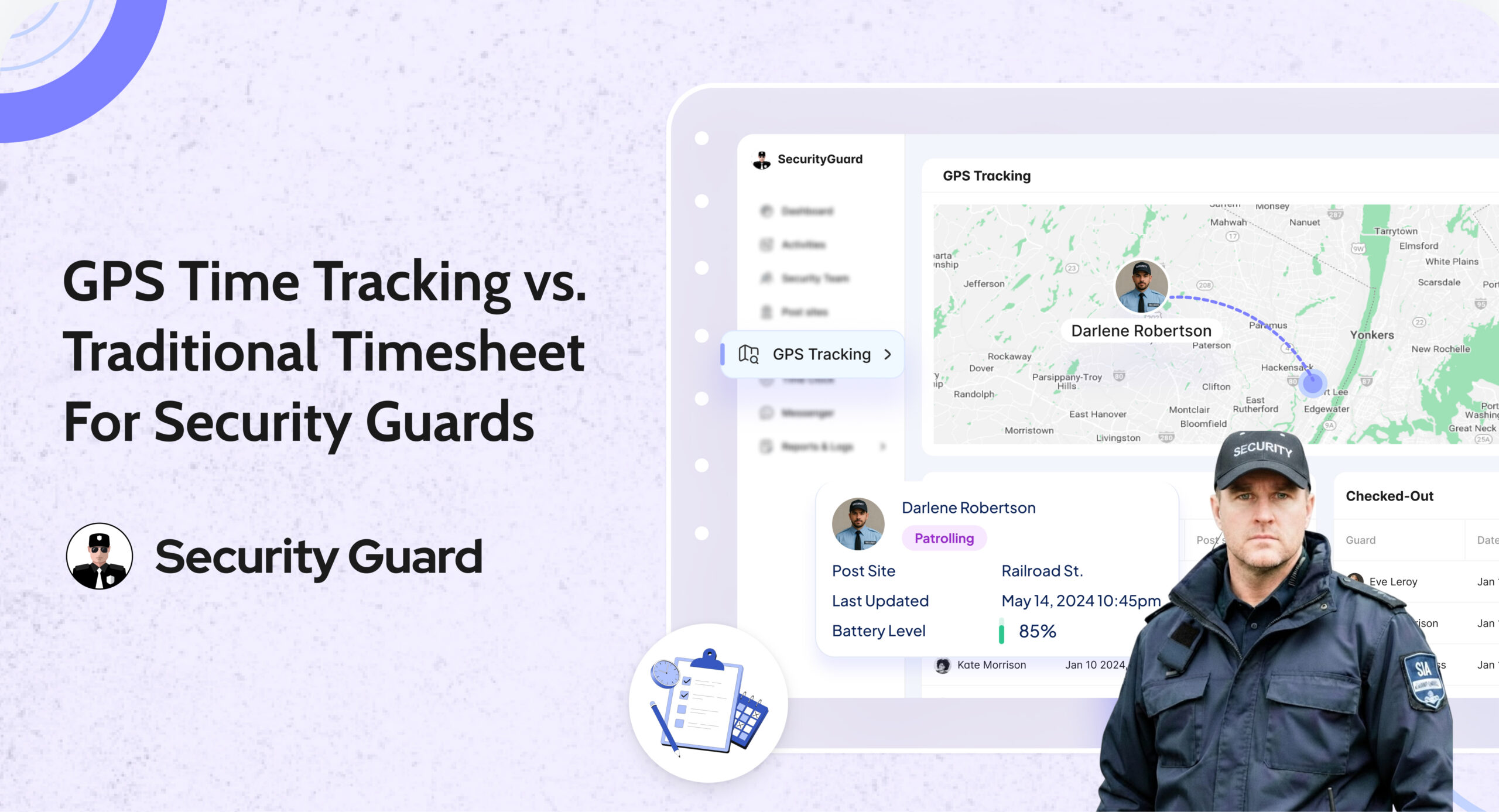
Accurate security guard time tracking is essential for every security company to maintain proper attendance records and ensure guards follow scheduled working hours. Tracking employees becomes more challenging when guards are assigned to multiple client sites. Traditional timekeeping methods can be unreliable because guards may not always record their actual shift start and end times correctly.
With a location-based clock-in system, supervisors can verify when and where guards clock in and clock out. This provides better visibility, improves accountability, and makes attendance management easier. In this blog, we will compare traditional timesheets with GPS-based time tracking and explain which method is more suitable for modern security operations.
What is Security Guard Time Tracking?
Security companies need an effective way to manage guard attendance, working hours, breaks, and overtime. Traditionally, paper logs were used to record clock-ins and clock-outs. However, these records do not provide supervisors with the guard’s location or reliable proof of when the shift actually started.
Traditional methods also make it difficult to record break times accurately. Calculating total working hours, overtime, and breaks manually can become complicated, especially when managing a large security team. These challenges are why many security companies are moving toward modern digital time management systems.
What are Traditional Timesheets for Security Guards?
Traditional timesheets rely on guards manually recording their arrival and departure times. Since these records are maintained on paper, there is a possibility that they may be lost, damaged, or incorrectly recorded. Missing records can also create complications during payroll processing or future investigations.
Supervisors may need to review the complete time log for each guard before calculating salaries. This can be time-consuming, particularly when several guards are working across different sites. If a guard forgets to record a clock-in, they may later enter the time manually when clocking out, which can affect the accuracy of attendance records.
These limitations make traditional timekeeping difficult to manage as a security company grows.
How Does GPS Time Tracking Work?
With a GPS clock in security guards can record their attendance from their assigned work location using a smartphone. Once they arrive at the site, they can clock in through the mobile application.
GPS tracking verifies the guard’s location during the clock-in process. Geofencing can prevent guards from clocking in when they are outside the permitted work area. This helps supervisors confirm that guards are present at the correct site.
For example, if a guard is scheduled for an eight-hour shift, the system records the clock-in and clock-out times and calculates the total working hours. Supervisors can then use these records to review attendance and support accurate payroll processing.
GPS Clock-In vs. Traditional Clock-In
GPS-based clocking and traditional clocking provide very different levels of visibility and accuracy.
With GPS clocking, guards can record attendance directly from their assigned locations using their mobile devices. Traditional clocking generally requires guards to manually record their attendance, which can lead to inaccurate or incomplete information.
A digital system allows supervisors to access attendance records within seconds, while reviewing paper logs can take considerably longer. Managing multiple sites is also easier because attendance information can be viewed from a centralized dashboard instead of maintaining separate logbooks for every location.
Digital records also provide stronger accountability because attendance information is automatically recorded. Paper records, on the other hand, can be lost, damaged, or manually altered.
How GPS Time Tracking Improves Payroll Accuracy
Automated clock-in and clock-out records reduce the need for manual calculations. The system can calculate total working hours and provide accurate attendance information for payroll processing.
Overtime and break records can also be tracked more efficiently. This helps supervisors identify additional working hours and ensure guards are compensated correctly.
GPS verification provides additional confidence that guards spent their scheduled working hours at the assigned site. Accurate attendance records can also help reduce payroll disputes and make salary calculations easier to verify.
Can GPS Time Tracking Prevent Buddy Punching?
Buddy punching is easier to perform when attendance is recorded manually. A guard could potentially record attendance for another employee without the supervisor knowing.
A modern GPS time tracking system helps reduce this risk by verifying the location from which the guard clocks in. The time clock for security guards can use location-based restrictions to ensure that clock-ins happen at approved work sites.
Geofencing can further restrict clock-ins to the assigned location. This provides stronger attendance security and helps supervisors maintain reliable records of guard working hours.
How Time Clock For Security Guards Supports Multiple Sites
Managing attendance across multiple client locations can become challenging without a centralized system. Supervisors need to know which guards have arrived, which employees are late, and whether each site has the required coverage.
A centralized system allows managers to monitor attendance across multiple sites from one dashboard. Location-based clock-in rules can ensure guards record their attendance from their assigned locations.
Supervisors can also identify guards who have not arrived and contact them when necessary. Payroll information for different locations can be managed more efficiently through the same system.
These capabilities make a GPS guard tracking solution valuable for security companies managing multiple teams and client sites.
Benefits of a Digital Guard Clocking System
A digital clocking system can make attendance management faster and more reliable. Key benefits include:
- Faster clock-in and clock-out processes.
- Reduced paperwork and manual data entry.
- More accurate attendance records.
- Automatic calculation of working hours.
- Easier payroll processing.
- Better supervisor visibility.
- Reduced attendance disputes.
- Easier reporting and auditing.
- Improved guard accountability.
- Centralized attendance management.
Limitations of Traditional Time Sheets
Traditional timesheets depend heavily on manual data entry, which increases the possibility of human errors. Supervisors may also find it difficult to verify whether guards were actually present at their assigned locations.
Paper records can be lost or damaged, making it difficult to retrieve important attendance information when needed. Delayed reporting can also prevent supervisors from taking immediate action when attendance problems occur.
As the security team grows, managing multiple sites, rotating shifts, and different schedules through paper records becomes increasingly difficult. Inaccurate attendance records can also create disputes between guards, supervisors, and clients.
When Should Security Companies Choose GPS Time Tracking?
A small security company with only four to six guards working within a limited area may be able to manage attendance manually. However, as the number of guards and client locations increases, manual timekeeping can become more difficult and time-consuming.
If supervisors are spending too much time reviewing paper logs or correcting attendance records, it may be time to consider a GPS guard clocking system.
GPS-based time tracking is especially useful for companies managing mobile security teams and multiple client sites. Guards can travel directly to their assigned locations and record their attendance without needing to visit the headquarters first.
Growing security companies can use digital attendance records to improve operational efficiency and provide clients with reliable proof of guard attendance when required.
How to Choose The Right Security Guard Time Tracking Solution
When selecting a time tracking solution, security companies should consider the following features:
- GPS and location verification.
- Easy mobile clock-in and clock-out.
- Geofencing.
- Real-time attendance visibility.
- Overtime and break tracking.
- Payroll integration.
- Automated reports.
- Offline functionality.
- User permissions and data security.
- Ease of use for guards and supervisors.
- Scalability for future business growth.
- Customer support and training.

Conclusion

Now you have a better understanding of GPS time tracking for security guards and how it can improve attendance management. A well-organized time tracking system helps security companies maintain accurate records, improve accountability, and simplify payroll operations.
Some companies may assume that implementing GPS-based time tracking is expensive, but the right Security Guard App can provide an affordable way to modernize attendance management. Exploring the available features through a free trial can help you determine whether the solution meets your company’s operational needs.
FAQ
1. What is GPS time tracking for security guards?
GPS time tracking records guard clockin and clockout times while verifying their location, improving attendance accuracy and accountability.
2. How does GPS clockin work for security guards?
Guards clockin using a mobile device, while GPS confirms they are at the assigned location before recording their attendance.
3. What is the best time clock for security guards?
The best time clock should offer GPS verification, easy mobile access, accurate time records, reporting and payroll support.
4. Can GPS time tracking prevent buddy punching?
GPS tracking can reduce buddy punching by verifying the guard’s location during clock-in and clock-out.
5. What is the difference between a guard clocking system and a traditional timesheet?
A guard clocking system automate attendance and can verify locations, while traditional timesheets rely mainly on manual entries.
Leave A Comment